
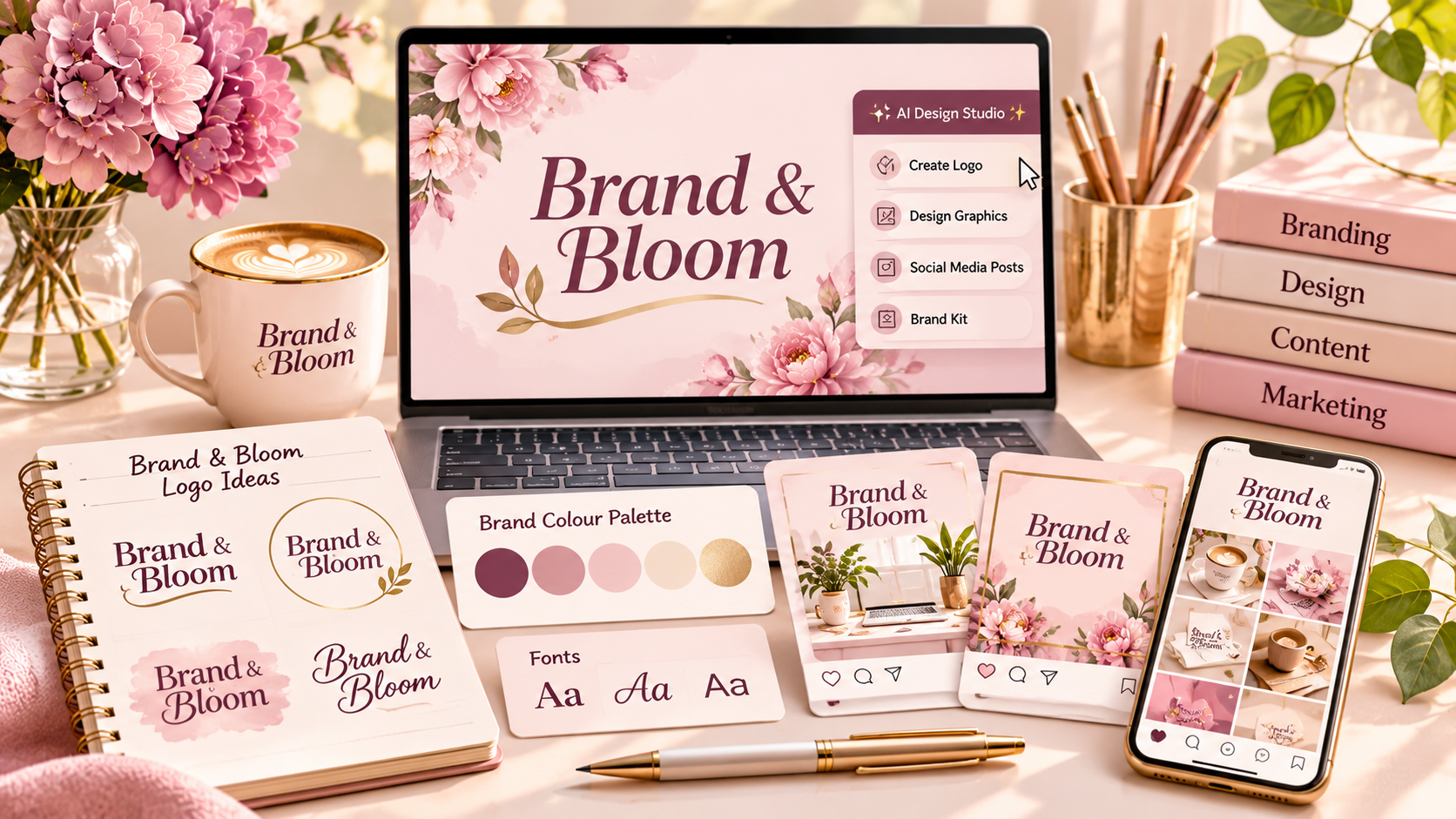
Branding your business as a woman entrepreneur comes down to four decisions you can make in one sitting: who you serve, what you stand for, how you sound, and how it looks. A logo is the last and smallest of them. Most early businesses lose weeks on color palettes and logo mockups before they have answered the first question, which is who the business is for.
This guide works as a worksheet. Open a blank document or grab a notebook, and write your answers as you go. Each section ends with a short exercise, and by the end you will have a completed Brand Blueprint, a first-week plan, and a checklist to test your foundation.
Every example below is an illustrative sketch made up for this guide, not a real business. They show how the same decision plays out in different kinds of work.
Your first exercise (5 minutes):
Create a document titled “My Brand Blueprint.” Add seven headings: Purpose, Ideal Customer, Problem Solved, Brand Promise, Personality, Voice, Visual Identity. You will fill these in section by section, and the full template appears later.
Name the woman you serve and the problem you solve for her
“Women” or “busy professionals” is too broad to write for. A brand speaks to one recognizable person in one recognizable situation. When you describe her closely, the right words, prices, photos, and channels become much easier to choose.
Describe her by her situation rather than her demographics. Age and location matter less than what she is trying to do and what is in her way.
Here is how that looks across different businesses:
- Handmade candles: She is buying a gift for a friend who has everything, and she wants something that looks considered without taking an afternoon of shopping. The problem is gift anxiety.
- Jewellery: She wears the same two pieces every day because most jewellery she finds is either too delicate to last or too loud for work. The problem is a lack of durable, understated pieces.
- Career coaching: She is a mid-level manager who keeps getting good reviews and no promotion. The problem is that she does not know how to make her work visible.
- Consulting: She runs a small studio and has outgrown doing the bookkeeping and scheduling herself. The problem is that she has no systems and no time to build them.
- Wellness: She has a desk job, a sore back, and no patience for hour-long routines. The problem is that she needs short movement sessions she will actually do.
- Creative services: She is launching a product and needs photos that look professional before her launch date. The problem is that she has no photographer and no idea what to brief one on.
Notice that each problem can be said in one plain sentence. If yours takes a paragraph, you are probably describing two customers. Pick the one you would most like to work with.
Exercise (10 minutes): Fill in these two sentences in your Blueprint, then read them aloud.
- “The woman I serve is ________, and right now she is struggling with ________.”
- “I help her by ________, so that she can ________.”
If a friend could not picture a real person from your first sentence, add one more concrete detail about her day.
Write down what you stand for in plain words
What you stand for is the set of beliefs that decides how you run the business. It shows up in how you price, what you refuse to sell, how you treat a client who is unhappy, and what you say in a product description. A customer who shares those beliefs stays; one who does not usually leaves, and that is useful to know early.
You do not need a grand mission statement. You need a few honest sentences you would actually act on. Some illustrations:
- A wellness practitioner might stand for sessions short enough to fit into a workday, with no recommendation she would not follow herself.
- A consultant might stand for fixed prices quoted before work begins, so clients never wonder what the bill will be.
- A jeweller might stand for pieces repaired for free in the first year, which tells customers she builds things to last.
Each of these is a decision with a consequence for the business. That is what separates a belief from a slogan.
Your brand promise comes from here. It is one sentence that tells the customer what she can count on every time she deals with you. “Every candle ships in recyclable packaging and arrives within five days” is a promise only if you can keep it, so write the version you can deliver on an ordinary Tuesday.
Exercise (15 minutes):
- Write three beliefs about how your kind of work should be done.
- For each belief, write one thing you will do because of it and one thing you will refuse to do.
- Combine your strongest belief and your clearest action into one brand promise sentence.
- Check it: could you keep this promise to your hundredth customer as well as your first? If not, shrink it until you can.
Find your voice by writing the way you talk to a client
Your voice is how your brand sounds in writing: the length of your sentences, the words you reach for, whether you use humor, whether you say “you” or “we.” Most women founders already have one. It tends to disappear when they sit down to write “professionally” and produce something stiff and generic.
The quickest way to find it is to start from speech. Explain your business out loud the way you would to a client sitting across from you, then write that down.
A few ways voice differs across the examples:

- The coach speaks directly and a little firmly: “Your last review said you exceeded targets. Let’s make sure the right people know.”
- The candle maker is warm and short: “Light it, sit down, and notice the room get quieter.”
- The consultant is precise and calm: “You will have a documented process by the end of week three.”
None of these is better than the others. Each fits its customer and its owner.
Pick three adjectives for your personality (for example warm, direct, playful, calm, precise), and make sure they sound like you rather than like the brand you admire. Then give yourself a short list of words and phrases you will use, and a short list you will avoid.
Exercise (20 minutes):
- Record a voice note on your phone explaining what you do to the woman you described earlier. Keep it under two minutes.
- Type it out, or use your phone’s built-in dictation to do it.
- Highlight the phrases that sound most like you and the ones that sound like a brochure.
- Rewrite your one-sentence business description using only the highlighted, natural phrases.
- Add your three personality words and your “words I use / words I avoid” lists to the Blueprint.
Choose a few visual basics and stop there
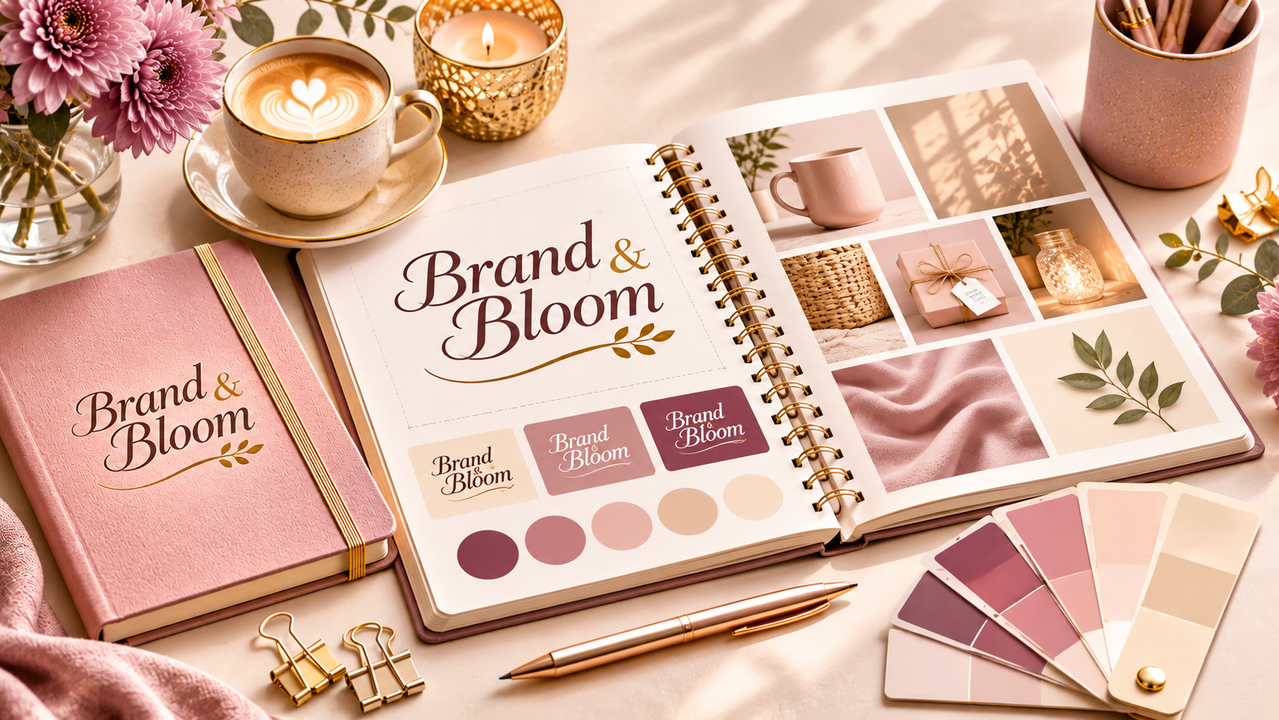
Visual identity is the smallest decision here, and it is also the easiest to overspend on. At the start you need only a handful of choices, made once and used consistently. Consistency does more for recognition than polish does.
Here is the whole list:

- Two main colors and one neutral. Choose colors that match your personality words. A calm consultant and a playful stationery designer should not end up with the same palette. Write down the exact color codes (a free color picker will show them), so you can reuse them exactly.
- Two fonts. One for headings and one for body text. Pick from the free fonts your website builder or design tool offers, and keep them for everything.
- A simple logo. Your business name typed in your heading font and your main color counts as a logo. You can commission something custom later when the business has earned it.
- A photo style. Decide on light or dark, bright or muted, close-up or wide. A jeweller photographing every piece on the same plain surface in natural window light will look more professional than one using a different backdrop every time.
You can make all of this in a free design tool or even a word processor. You do not need design training.
Exercise (20 minutes):
- Choose your two colors and one neutral, and copy their codes into the Blueprint.
- Choose your two fonts.
- Type your business name in the heading font and main color, and save it as your first logo.
- Take three photos of your work or workspace in the style you chose, and save them in one folder named “Brand.”
Then stop. Resist adjusting anything for at least a week.
Give your brand a home you own: your website
Social media profiles are useful, but you borrow them. The platform sets the rules, controls who sees your posts, and can change its format or close an account. A website is the one place where your name, colors, words, and offers sit together, and nobody else decides how they appear.
For a brand that is still taking shape, a small site is enough. Four pages cover it:
- Home: your one-sentence description, your promise, and a clear next action.
- About: who you serve, what you stand for, and a short note on how you work.
- Offer page: your shop, services, or packages, with plain descriptions and prices where you can share them.
- Contact: a form or email address so customers can reach you.
Everything you have written so far feeds these pages. Your customer sentence becomes the homepage headline. Your beliefs go on the About page. Your voice sets the tone of every line, and your colors, fonts, and photos fill the layout.

Exercise (20 minutes): Sketch your four pages on paper. Under each, write the one sentence you want a visitor to read first, taken from your Blueprint. You now have the outline for the site.
Your first week of branding, day by day
First, here is the complete Brand Blueprint. Copy it into your document and complete every line. Short answers are fine.
Your Brand Blueprint
- Business purpose: I started this business to ________ for ________.
- Ideal customer: She is a ________ who wants ________ and is held back by ________.
- Problem solved: The main problem I solve for her is ________.
- Brand promise: Every time she works with me, she can count on ________.
- Personality: My brand is ________, ________, and ________.
- Voice: I write in ________ sentences. I often say ________ and I never say ________.
- Visual identity: My colors are ________, ________, and ________. My fonts are ________ and ________. My photos look ________.
Now spread the work across seven days. Each day takes 20 to 30 minutes.
- Day 1: Write your customer and problem sentences.
- Day 2: Write your beliefs and your brand promise.
- Day 3: Record your voice note and choose your personality words.
- Day 4: Choose colors, fonts, and your text logo.
- Day 5: Take and save your first three brand photos.
- Day 6: Draft the text for your Home and About pages, using your Blueprint answers.
- Day 7: Read everything aloud, fix what sounds unlike you, and set up your website.
If you fall behind, pick up where you stopped. Finishing day 7 a few days late still leaves you with a brand.
Your Brand Launch Checklist: Are You Ready to Go Public?
Use this list to test your foundation. Tick each item only if you can honestly say yes.
Audience and problem
- I can describe my ideal customer in one sentence.
- I can state the problem I solve in one plain sentence.
Purpose and promise
- I know what I stand for and have acted on it in at least one business decision.
- My brand promise is something I can keep every time.
Voice
- I have three personality words that sound like me.
- A stranger reading my description would hear how I actually talk.
Visuals
- I have two colors, one neutral, and two fonts, saved with exact codes.
- I have a simple logo and at least three photos in a consistent style.
Home
- I have an outline for Home, About, Offer, and Contact pages.
- I have a plan to put my brand on a website I own.
Eight or more ticks means you are ready to publish. If you have fewer, return to the section behind the unticked items and spend ten minutes on it. Nothing here needs to be perfect, because you will adjust your brand as real customers respond to it.
Ready to Bring Your Brand to Life?
You’ve defined your brand’s purpose, audience, personality and visual direction. Now it’s time to turn those ideas into a visual identity!
Imagine creating your own business logo, choosing your brand colours, designing images and preparing social media content – all with the help of AI.
With Wealthy Affiliate’s Studio, you can explore AI-powered creative tools to help bring your brand to life.
Ready to create your brand identity?
Explore Wealthy Affiliate and start creating your brand
You don’t need to be a professional designer to get started:)

