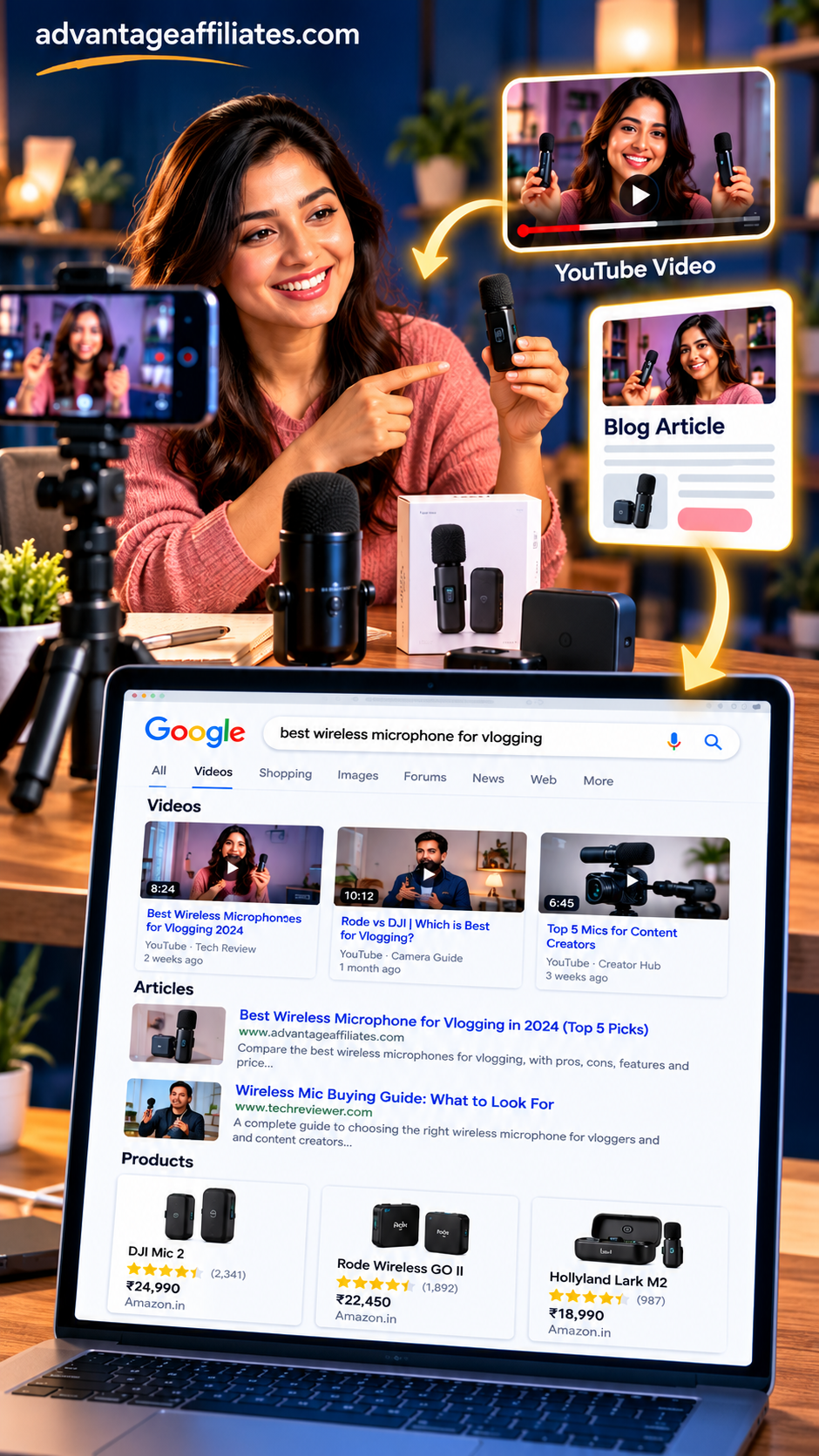

What if the keyword that brings you your next buyer isn’t the biggest keyword in your niche? The secret may be using the right best keyword strategies to uncover specific searches with strong buying intent.
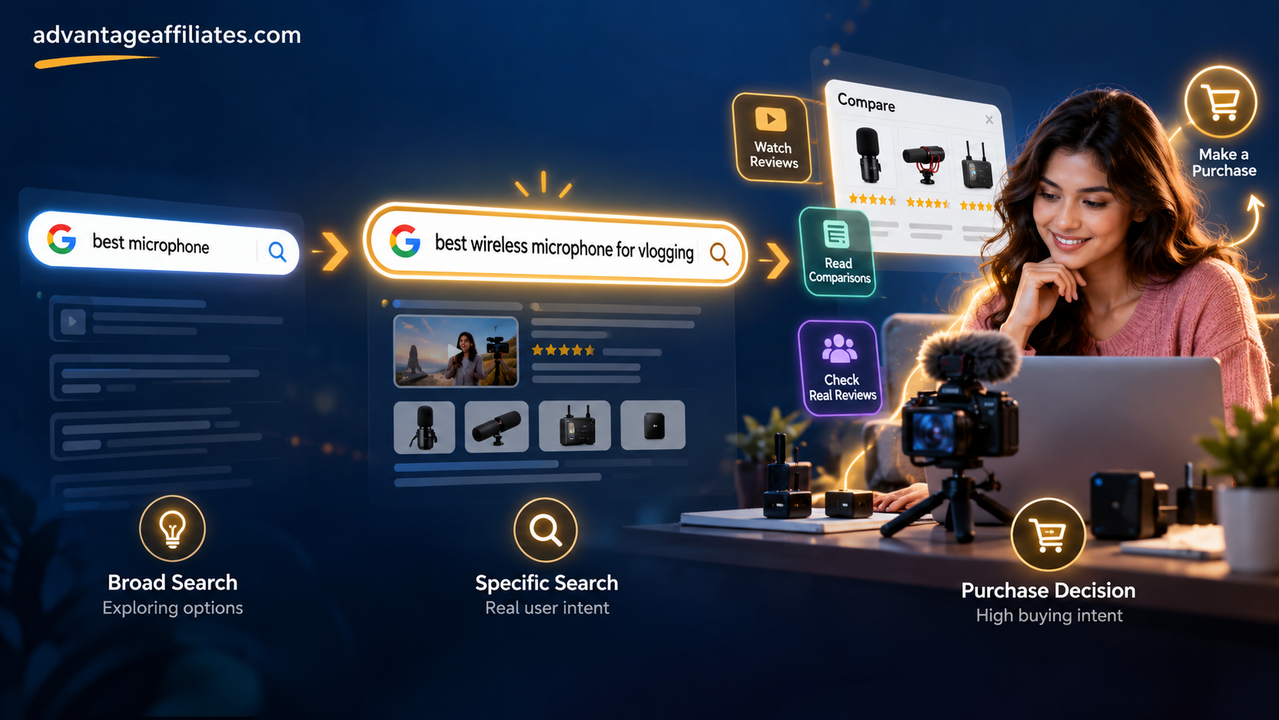
Instead of fighting for something broad like “best microphone,” you could target a much more specific search such as “best wireless microphone for vlogging” or “best wireless microphone that works with iPhone.”
That small change can completely change the conversation.
The goal is not simply to find a keyword with the word “best” in it. The real opportunity is to understand why someone is searching, what they want to accomplish, and what kind of content Google is already showing them.
That is where these best keyword research and strategies become especially useful.
TL;DR
- Start with a broad root topic, such as “best wireless microphone.”
- Add for, that, or with to create more specific, natural-language keyword variations.
- Use Google autocomplete, sometimes called the Alphabet Soup Method, to discover real search phrases people are typing.
- Do not automatically create a blog post for every keyword.
- Search, Look, Assess: search the keyword, inspect the search results, and assess what content format Google is rewarding.
- If you see videos, consider making a video. If you see articles, create an article. If you see Reddit or forum discussions, consider participating in that format where appropriate.
- Build a content ecosystem: a main article can connect with video, social content, and relevant community discussions.
- Use AI to help create content, but use real keyword and search data to validate the opportunity.
- Put the target keyword naturally into important elements such as the article title, video title, description, and relevant supporting content.
Why “Best” Keywords Matter

People search for information at different stages of a buying journey.
Someone searching for “wireless microphone” may simply be researching what a wireless microphone is.
Someone searching for “best wireless microphone” has moved closer to a buying decision. They have already decided they probably need one and now want help choosing.
Add another layer:
“best wireless microphone for vlogging”
Now we know more about the person’s situation.
They are not looking for just any microphone. They have a particular use case: vlogging.
This is the power behind one of the core best keyword strategies in the training: take a root topic and make it more specific.
The training notes also point out that seasonal changes can create buying opportunities. Fall, for example, can bring changes in clothing, food, travel, home organization, and back-to-school needs. Whenever people’s circumstances change, their searches and spending habits can change too.
So keyword research is not only about search volume. It is also about understanding what people are trying to do right now.
Recommended Read: Keyword Research – What and Why ?
The Three-Word Method: For, That, and With
One of the simplest techniques in the training is to use three connector words:
for + that + with
Think of these words as little bridges between a broad topic and a specific user situation.
1. Use “for”
Start with your root topic:
best wireless microphone
Add for and then describe the audience, purpose, or situation:
- best wireless microphone for vlogging
- best wireless microphone for content creators
- best wireless microphone for filmmaking
- best wireless microphone for singing
- best gimbal for iPhone
Notice what happened.
The keyword became longer and more specific.
Instead of trying to create one enormous piece of content around “wireless microphone,” you now have several highly targeted content opportunities.
2. Use “that”
The word that helps capture a specific feature, requirement, or problem.
For example:
- best wireless microphone that works with iPhone
- best gimbal that can shoot vertical
- best gimbal that moves with you
These searches reveal something important: the searcher has a condition they want the product to satisfy.
That gives you a strong content angle.
3. Use “with”
“With” can identify a feature, capability, or characteristic:
- best wireless microphone with long range
- best camera with image stabilization
- best laptop with long battery life
Again, the keyword becomes much more specific than the broad root topic.
Why this works
Earning BEST Commissions in the World of AI WAbinar describes these longer keywords as a way to create more personalized search queries and potentially reduce competition compared with very broad terms.
More importantly, these phrases often sound like the way a real person would ask a question.
That matters because modern search increasingly handles conversational and detailed queries.
The Alphabet Soup Method for Finding Keyword Ideas
The Alphabet Soup Method is a simple way to discover more real search queries directly from a search engine.
Instead of only typing your target keyword and looking at the results, you take your target keyword and add a letter of the alphabet after it.
For example, start with:
best wireless microphone
Then try:
- best wireless microphone a
- best wireless microphone b
- best wireless microphone c
- best wireless microphone d
…and continue through the alphabet.
The search engine’s autocomplete suggestions can reveal additional phrases people are searching for.
How the Alphabet Soup Method works
Let’s say your target keyword is:
best wireless microphone
Go to Google and type:
best wireless microphone a
Look at the suggested searches.
Then try:
best wireless microphone b
Check the suggestions again.
Continue with:
best wireless microphone c
Then d, e, f, and so on.
You are essentially using the alphabet to uncover variations around your target keyword.
You can also combine this technique with the for, that, and with method.
For example, you might start with:
best wireless microphone for
Then investigate the suggestions.
Or you can take a more specific target keyword and use the alphabet after it to uncover additional variations.
Why this is useful
The suggestions shown by search engines are based on what people have been searching for and typing into the search engine.
That makes the Alphabet Soup Method useful for discovering phrases you may not have thought of yourself.
For example, instead of stopping at:
best wireless microphone
you may discover more specific searches related to:
- vlogging
- content creators
- filmmaking
- phones
- speaking
- singing
- live performance
These can become potential keyword ideas for articles, videos, social posts, or other useful content.
A simple Alphabet Soup workflow
- Choose your target keyword.
- Type the keyword into your search engine.
- Add a after the keyword and check the suggestions.
- Repeat with b.
- Continue through the alphabet.
- Record useful search phrases you discover.
- Validate promising keywords using your available keyword research data.
- Search the strongest keywords and assess the SERP before deciding what content to create.
The important point is that you are not guessing what people might search for. You are using the search engine’s own suggestions to uncover additional keyword possibilities.
Search, Look, Assess: Read the SERP Before You Create
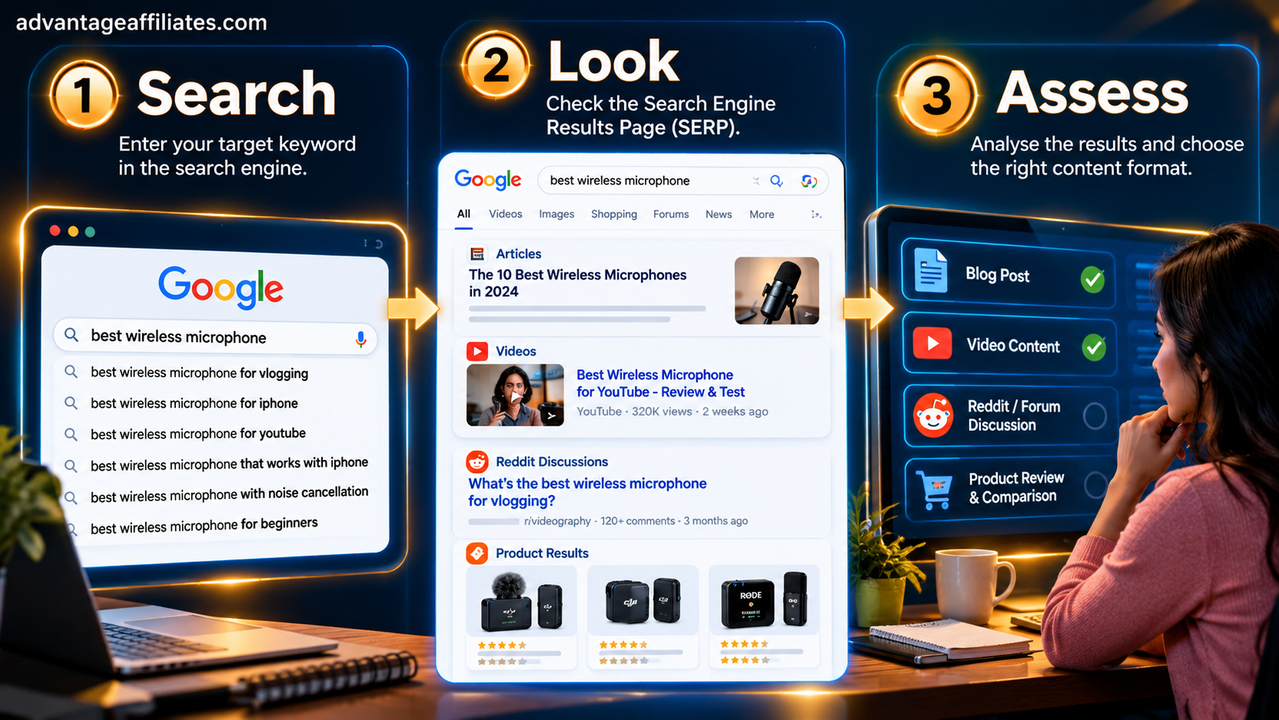
Finding a keyword is only half the job.
The next step is one of the most important best keyword strategies in the training:
Search. Look. Assess.
Step 1: Search
Type the exact target keyword into Google.
Do not assume you already know what Google wants to show.
Actually search it.
Step 2: Look
Study the Search Engine Results Page, commonly called the SERP.
Look at what appears:
- Blog posts
- YouTube videos
- Reddit discussions
- Forums
- Product results
- Shopping results
- AI-generated search summaries
- Social media content
Step 3: Assess
Now ask:
“What type of content is Google showing for this query?”
This is the part that can save you a lot of wasted effort.
Imagine your keyword is:
best wireless microphone for vlogging with phone
If the search results prominently feature videos, that is a signal that video content may be useful for this query.
If the results contain strong written guides, an article may make sense.
If Reddit discussions appear prominently, there may also be an opportunity to participate in a genuine community discussion.
The point is not to blindly copy what is already ranking.
The point is to understand the content format and search intent Google is surfacing.
Why Content Diversification Matters
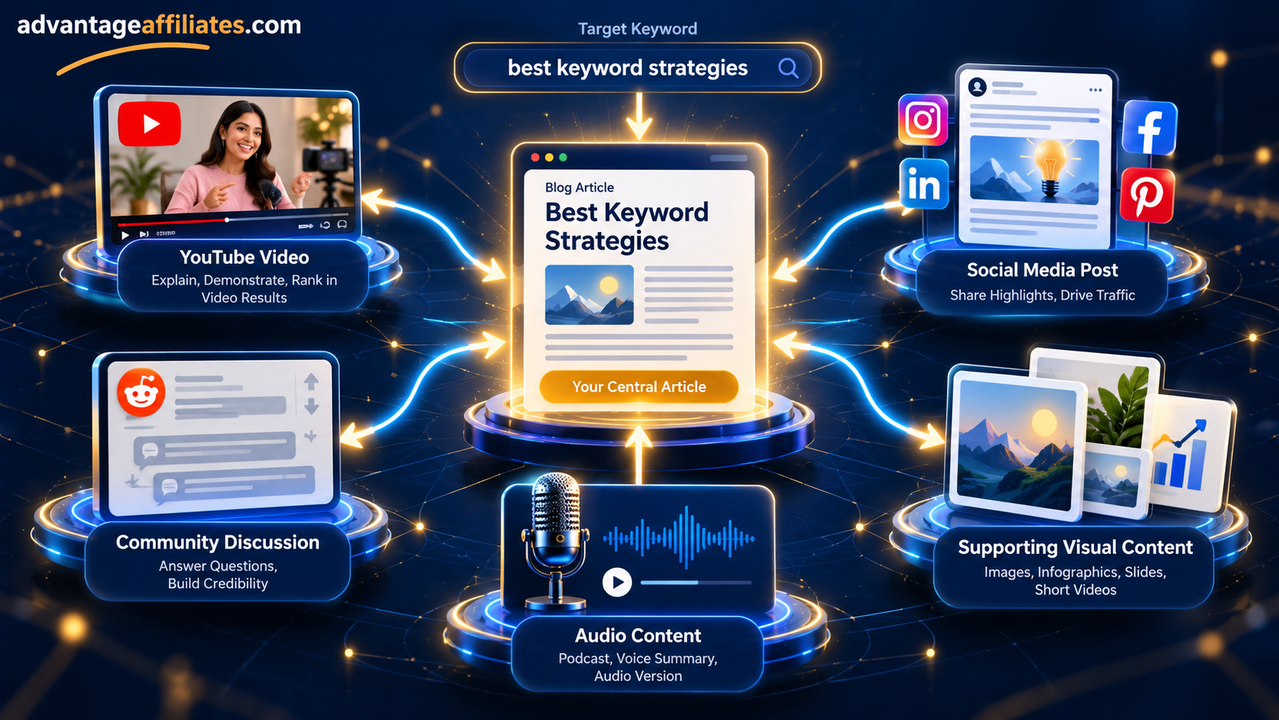
One of the biggest ideas in the training is that content does not have to mean “another blog post.”
Content can be:
- An article
- A YouTube video
- A social media post
- A relevant Reddit discussion
- An audio or spoken explanation
- Product comparisons
- Supporting visual content
This creates a more flexible approach to SEO.
For example, suppose your main keyword is:
best gimbal that can shoot vertical
You might create:
- A detailed article answering the question.
- A video demonstrating vertical shooting.
- A social post summarizing the key points.
- A relevant community discussion where you genuinely add value.
- Supporting images showing the gimbal in use.
The central article can become the hub.
Other content can point interested people back to that main resource where appropriate.
This is what the training describes as creating a “marriage” between different types of content.
Instead of one lonely article sitting on your website, you have a small content ecosystem.
How Video Fits Into Modern Search
The training places particular emphasis on video because video results can appear prominently for product-related and “best” searches.
For example, a search for a product may display videos alongside written articles, product listings, and discussions.
That creates an opportunity for content creators who are willing to move beyond text.
You do not need a Hollywood studio.
A simple product demonstration, comparison, tutorial, or hands-on explanation can become useful video content.
For video SEO, the training recommends placing the target keyword in relevant areas such as:
- Video title
- Video description
- Video content
- Link back to the main article
The goal is to make the relationship between your video and your main topic clear.
For example:
Article: Best Wireless Microphone for Vlogging
Video: Best Wireless Microphone for Vlogging — Real-World Test
Social post: What Is the Best Wireless Microphone for Vlogging?
The same topic appears across formats, but each piece serves a slightly different purpose.
Build a Content Ecosystem Around One Keyword
A useful way to think about SEO today is to stop treating each piece of content as an isolated project.
Instead, create a small ecosystem around one strong keyword.
Here is a simple model:
Keyword → Main Article → Video → Social Content → Relevant Community Discussion
The article acts as the central resource.
The video demonstrates or explains.
Social content creates another discovery path.
A relevant community discussion can answer questions and introduce the topic to people already interested in it.
Meanwhile, links between your own relevant content can help users move naturally from one resource to another.
However, there is an important distinction: do not create low-value posts simply to manufacture links.
If you participate in Reddit or another community, the discussion should actually help people.
The same principle applies to social media.
Useful content first. Promotion second.
How AI Can Help Without Replacing Keyword Research
AI can be extremely useful once you know what you are trying to create.
You can use it to help:
- Expand keyword ideas
- Build article outlines
- Turn research into drafts
- Generate video scripts
- Create FAQs
- Develop social media variations
- Suggest content angles
- Repurpose an article into multiple formats
However, the training makes an important distinction.
AI chatbots are not necessarily the best source for determining whether a keyword is actually being searched.
For that, the training recommends using harder data sources such as keyword research tools and Google Search Console, along with Google autocomplete and direct SERP analysis.
A simple way to think about it is:
Use data to choose the opportunity.
Use AI to help produce the content.
That combination is much stronger than asking AI to invent a keyword and assuming it is valuable.
A Practical Example: From Root Keyword to Content Plan
Let’s walk through the process.
Suppose your niche is filmmaking.
Your root topic is:
best gimbal
Now apply the three connectors.
For
- best gimbal for iPhone
- best gimbal for smartphone
- best gimbal for content creators
That
- best gimbal that can shoot vertical
- best gimbal that moves with you
- best gimbal that works with Android
With
- best gimbal with long battery life
- best gimbal with tracking
- best gimbal with stabilization
Now choose one promising phrase.
For example:
best gimbal that can shoot vertical
Search it.
Look at the SERP.
Assess the results.
Suppose you find a mixture of:
- Videos
- Blog posts
- Product results
- Reddit discussions
That gives you several possible content formats.
You could create a detailed article, demonstrate the feature in a video, create supporting social content, and participate in a relevant discussion if you have something genuinely useful to add.
The keyword research has now become a content strategy.
Best Keyword Strategies Checklist
Before publishing content, run through this checklist:
- Do I have a clear root topic?
- Did I test for?
- Did I test that?
- Did I test with?
- Did I check Google autocomplete?
- Did I validate the keyword using appropriate data?
- Did I search the exact keyword?
- Did I study the SERP?
- Did I identify the dominant content formats?
- Did I choose a format that matches the search results?
- Did I include the keyword naturally in important on-page elements?
- If I created a video, did I optimize its title and description?
- Does the video or supporting content connect back to the main article?
- Am I creating genuinely useful content rather than content simply for links?
If you can answer “yes” to most of these questions, you are no longer guessing your way through keyword research.
You are making decisions based on what the search landscape is actually showing you.
Final Thoughts
The biggest lesson from these best keyword strategies is simple:
Do not just find keywords. Learn what the search results are telling you.
A broad keyword can give you a topic.A long-tail keyword can give you a specific audience and situation.
The SERP can tell you what type of content that audience expects.
And content diversification can help you meet that search intent in more than one format.
So the next time you find a promising “best” keyword, do not immediately open your writing tool and start typing.
Search smarter, create for the actual query, and let the SERP help decide the format.
FAQ: Best Keyword Strategies
What are the best keyword strategies for affiliate marketing?
A strong approach is to start with a root topic, add modifiers such as for, that, and with, use Google autocomplete to discover specific phrases, and then study the SERP before deciding what content to create.
What is the “for, that, with” keyword strategy?
It is a long-tail keyword technique that adds for, that, or with between a root topic and a specific use case, feature, or audience. For example, “best microphone” can become “best wireless microphone for vlogging.”
What is the Alphabet Soup Method?
The Alphabet Soup Method uses Google autocomplete suggestions to discover search phrases related to a root keyword. Adding words such as “for,” “that,” or “with” can reveal more specific variations.
Should I use AI to find keywords?
AI can help brainstorm and expand ideas, but the training recommends validating actual keyword opportunities with search data, keyword research tools, Google Search Console, autocomplete, and SERP analysis.
What does “Search, Look, Assess” mean?
Search the target keyword, look carefully at the Search Engine Results Page, and assess what types of content are appearing. The result helps you decide whether an article, video, community discussion, or another format is appropriate.
Should every keyword become a blog post?
No. The SERP may show that users are being served videos, forums, product results, social content, or a mixture of formats. Match your content format to what the search results indicate.
Why are long-tail keywords useful?
Long-tail keywords are more specific and often describe a particular user, problem, feature, or situation. They can provide clearer search intent than broad keywords.
How can video support an SEO article?
Create a video around the same search intent, include the target keyword naturally in the title and description, and connect the video with the main article. This creates a stronger multi-format content ecosystem.
What should I do after finding a promising keyword?
Record it for follow-up research, validate the competition and search results, identify the dominant content formats, and then create the content that best matches the query.