
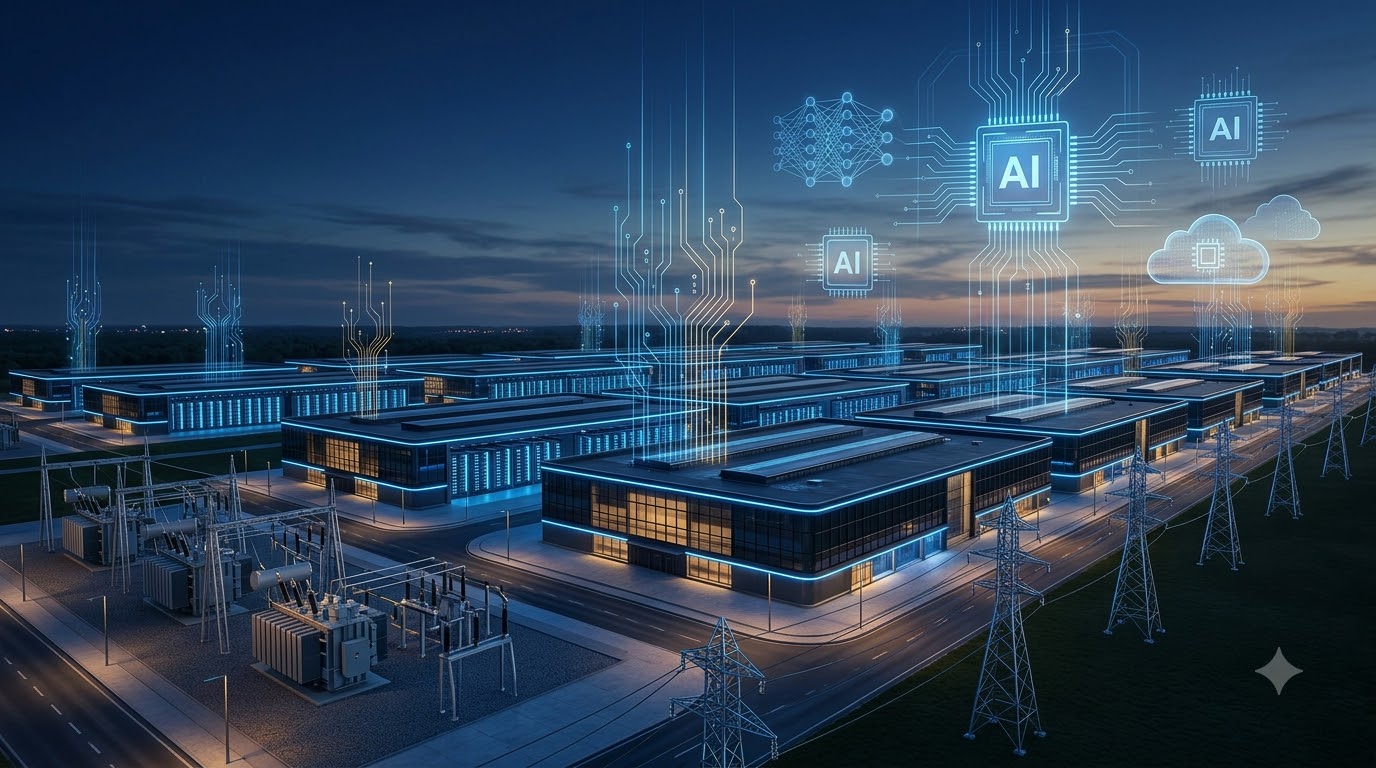
AI is no longer just about who launched the smartest chatbot. Behind the scenes, something much bigger is happening.
AI companies are locking in enormous amounts of computing power, investors are putting billions into AI infrastructure, model prices are changing, open-weight competitors are becoming stronger, and leading AI companies are beginning to show signs of serious commercial scale.
AI infrastructure is becoming the foundation underneath the rapid growth of artificial intelligence. While most people see the models and applications, enormous investments in computing power, data centers, chips and energy are making that growth possible.
In other words, AI is moving from the experimental stage into the infrastructure and business era.
Here are five important developments from this week’s AI landscape and, more importantly, what they mean for businesses and entrepreneurs.
1. OpenAI Secures Massive Ohio AI Data Center Capacity With Nvidia Backing
OpenAI announced an agreement involving the PORTS-Pike Technology Campus in Pike County, Ohio, with plans targeting approximately 8 gigawatts of IT capacity.
SB Energy, backed by SoftBank, will build, own and operate the facility under a 20-year lease arrangement. Nvidia is investing $1.5 billion in SB Energy and is providing credit support for the initial approximately 4.25 GW phase.
The project is expected to create tens of thousands of construction jobs along with long-term operating positions, with capacity expected to come online in phases beginning around 2028.
This is why AI infrastructure has become such an important part of the AI story. Better models are only useful if there is enough computing capacity to run them.
OpenAI’s announcement about the PORTS-Pike project
Nvidia’s announcement about the Ohio AI campus
Why Does AI Infrastructure Matter?
When we use an AI assistant, it can feel as though everything happens inside an invisible “cloud.”
It doesn’t.
AI runs on enormous amounts of physical infrastructure — chips, servers, networking equipment, cooling systems and electricity.
And increasingly, access to that infrastructure is becoming one of the biggest factors limiting how quickly AI can grow.
For years, the AI race was largely presented as:
Who has the smartest model?
Now another question is becoming equally important:
Who has enough computing power to run it?
The Ohio project is a good example of this shift.
The future of AI will depend not only on better algorithms, but also on access to power, land, chips and data centers.
What should businesses take away?
For small businesses, this doesn’t mean you need to start building a data center in your backyard!
It means the AI services you use are increasingly supported by massive infrastructure investments happening behind the scenes.
As that infrastructure expands, AI capabilities should become available to more businesses and users at scale.
2. Stripe and OpenRouter: Why Is AI Routing Suddenly Worth Billions?
One of the week’s most surprising stories is the reported acquisition of OpenRouter by Stripe for more than $7 billion.
OpenRouter provides developers with access to hundreds of AI models through a common interface.
However, there’s an important detail:
The deal has been reported by major media outlets, but Stripe has not officially confirmed it.
TechCrunch’s report on the reported Stripe–OpenRouter deal
Bloomberg’s report on the reported acquisition
So what exactly does OpenRouter do?
Imagine that you have access to hundreds of taxis.
One is cheaper.
Another is faster.
Another is better for long journeys.
Another is better for a particular destination.
Instead of manually choosing a taxi every time, you have a smart dispatcher that can decide which one makes the most sense.
That’s roughly the idea behind an AI model router.
A developer can connect to multiple AI models through one system instead of building everything around a single provider.
Why is that becoming so valuable?
AI businesses don’t necessarily want to depend entirely on one model.
Imagine your business uses one AI model for:
Customer support
Another for:
Coding
Another for:
Research
And another for:
Image generation
If one provider becomes expensive, unavailable or less capable, being able to switch can be extremely valuable.
This is often called reducing vendor lock-in — but the simple version is:
Don’t put your entire AI business in one basket.
The reported Stripe–OpenRouter deal suggests that the infrastructure sitting between businesses and AI models could itself become enormously valuable.
What does this mean for entrepreneurs?
This is especially interesting for anyone building AI automations.
The future may not be about finding the one best AI model.
It may be about building systems that can intelligently choose the right model for the right job.
3. DeepSeek Changes the Economics of Cheap AI
DeepSeek has moved its V4 Pro model into general availability while also introducing major changes to its API pricing structure.
The new pricing uses peak and off-peak rates, with some token categories seeing very substantial increases compared with earlier pricing.
Reuters’ coverage of DeepSeek V4 Pro
Coverage of DeepSeek’s V4 Pro pricing changes
Why Does AI Infrastructure Matter?
DeepSeek became famous partly because of its aggressive pricing.
That put pressure on the entire AI industry.
But now we’re seeing something interesting.
As AI usage grows — particularly with AI agents that can make many model calls — the economics become much more complicated.
A model that looks incredibly cheap for a simple question may have a very different cost profile when an automated agent makes hundreds or thousands of calls.
This is an important lesson for AI automation builders.
Don’t simply ask:
“Which AI model is cheapest?”
Ask:
“Which model gives me the best result for the total cost of the workflow?”
A slightly more expensive model that completes a task correctly on the first attempt may actually be cheaper than a cheaper model that requires multiple retries.
This is another reason multi-model routing could become increasingly useful.
4. Anthropic’s Revenue Shows That Enterprise AI Is Becoming Serious Business
Anthropic is reportedly showing extraordinary growth.
Documents shared with prospective investors reportedly indicate that the company generated more than $11.5 billion in preliminary Q2 2026 revenue, more than 14 times the year-earlier figure.
The figures are preliminary and unaudited, and the underlying investor documents have not been publicly released by Anthropic.
Bloomberg’s report on Anthropic’s reported Q2 revenue
Forbes coverage of Anthropic’s reported Q2 results
Why is this important?
For a long time, there was a big question hanging over the AI industry:
Can AI companies actually make enormous amounts of money?
The reported numbers from Anthropic suggest that enterprise demand for premium AI models and coding tools is becoming very significant.
Businesses aren’t just experimenting with AI anymore.
They’re increasingly paying for it.
That’s an important transition.
We can think about technology adoption in stages:
Curiosity → Experimentation → Adoption → Production → Budget
AI is increasingly moving toward the last two stages.
What does that mean for small businesses?
It means AI is becoming something businesses can reasonably treat as an operating expense rather than simply an experiment.
Instead of asking:
“Should we try AI?”
The better question may increasingly be:
“Where can AI save us time, increase revenue or improve customer service?”
That’s a much more useful question.
5. GLM-5.3 Shows Why AI Post-Training Is Becoming So Important
Z.ai has released GLM-5.3, building on the same approximately 743-billion-parameter base model as GLM-5.2.
What’s particularly interesting is that the reported improvements come from post-training, rather than simply creating a completely new base model.
The model has shown significant improvements in coding and agent-related benchmarks, as well as cybersecurity tasks.
Z.ai has also indicated that the weights are planned for open release following additional safety review.
TechNode’s coverage of GLM-5.3
What is post-training?
Here’s a simple analogy.
Imagine you hire someone who already has an excellent education.
That’s the base model.
Then you give that person months of specialized training:
coding
problem solving
working with tools
following instructions
handling long tasks
That’s roughly what post-training can do.
The interesting part is that AI companies are discovering that better training after the initial model is created can produce substantial improvements.
Why does that matter?
It could make AI development more efficient.
Instead of always needing to build a completely new giant model, companies can sometimes get significant improvements by making better use of the model they already have.
This is particularly important for open-weight AI competition.
It also means developers may have more powerful models available for building specialized applications and automations.
However, the cybersecurity capabilities also highlight an important issue:
More capable AI can be useful and potentially risky at the same time.
That’s why staged releases and additional safety testing are becoming increasingly common.
What Do These Five Stories Have in Common?
At first glance, these developments seem unrelated.
A giant Ohio data center.
A reported $7 billion AI acquisition.
DeepSeek changing its prices.
Anthropic generating billions in revenue.
A Chinese AI company improving an existing model through post-training.
But put them together and a much bigger picture appears.
AI is entering its infrastructure era.
The AI industry is moving beyond:
“Look how clever this model is!”
The questions are becoming much more practical.
Where will the computing power come from?
How much will AI cost?
How do businesses avoid being locked into one model?
Can AI companies become highly profitable?
How efficiently can models be improved?
Who controls the chips, power and infrastructure?
These questions will shape the next stage of the AI industry.
The Four Things Becoming Extremely Valuable in AI
Looking at this week’s news, four resources stand out.
1. Compute
AI needs enormous amounts of computing power.
The OpenAI–Nvidia–SB Energy project shows just how much infrastructure is being planned.
2. Electricity
AI data centers consume enormous amounts of power.
That means energy availability is becoming an important part of the AI conversation.
3. Distribution
Having a great AI model isn’t enough.
You need ways for developers and businesses to actually use it.
That’s where platforms and routing layers become valuable.
4. Customers
Ultimately, AI companies need businesses and consumers willing to pay for their services.
Anthropic’s reported revenue growth is an important signal that enterprise customers are increasingly doing exactly that.
What AI Infrastructure Means for Small Businesses
You don’t need billions of dollars to benefit from these changes.
In fact, small businesses may have one major advantage:
You can move faster.
Here are five things worth thinking about.
1. Don’t build your entire business around one AI provider
If your business relies heavily on AI, consider whether your workflow could switch models when necessary.
Flexibility is becoming increasingly valuable.
2. Watch your AI costs
Cheap AI isn’t necessarily cheap when an automation makes hundreds of calls.
Track the actual cost of your complete workflow.
3. Look beyond chatbots
The real opportunity isn’t simply putting a chatbot on your website.
Think about complete workflows:
Lead comes in → AI qualifies it → CRM is updated → WhatsApp message is sent → appointment is scheduled → follow-up happens automatically.
That’s where AI can create measurable business value.
4. Open-weight models are becoming interesting
As open and more accessible models improve, businesses and developers may have more options for specialized AI applications.
This could be particularly interesting for automation builders.
5. AI is moving into production
The biggest signal from this week’s news is that companies are spending serious money on AI because they expect serious returns.
That means the question for a small business isn’t necessarily:
“Is AI a fad?”
The more useful question is:
“Where can AI give my business an unfair advantage?”
The Bigger Picture
The AI industry is changing.
We’re moving from an era dominated by exciting demonstrations into an era where economics, infrastructure, reliability and business value matter just as much as model intelligence.
The next major AI breakthrough may not be a chatbot that scores a few points higher on a benchmark.
It could be:
- cheaper inference
- smarter AI agents
- better model routing
- more efficient training
- massive new computing infrastructure
- better enterprise integration
- or a small business discovering a way to automate an entire process that previously required several employees.
And that is perhaps the most exciting part.
You don’t have to build the next Nvidia or OpenAI to benefit from the AI revolution.
You can simply learn how to put the infrastructure they are building to work for your business.
The AI race is getting bigger.
But for entrepreneurs, the opportunity is getting bigger too.
At Advantage Affiliates, I also share resources and lessons from my own journey of building an online business. You can visit the Advantage Affiliates homepage to explore more.
